
Features
Operating principle
TIJ technology uses a cartridge with nozzles that briefly heat the ink to eject micro-droplets on demand. This process produces high-resolution marking. The replaceable cartridge eliminates the need for manual printhead maintenance. Water-based or solvent-based inks cover both porous and non-porous surfaces.
Integration
The printer is mounted on the line and codes as it passes onto cardboard, film, cases and labels. It receives the variable data to be printed and is controlled via an interface.
Options & configuration
Water-based or solvent-based inks, one or more print heads, barcode marking, DataMatrix, QR codes, logos and variable text, resolution adjustment according to the substrate.
Benefits
Clear and high-resolution marking.
Maintenance-free operation thanks to the replaceable cartridge.
Quick setup.
Compatibility with porous and non-porous surfaces depending on the ink.
Full traceability: dates, batches and codes.
Reduced bulk on the line.
Thermal inkjet printer specialists

ZENJET CODING
French manufacturer of industrial thermal inkjet printers and marking inks.
Agrifoods
Primary packagingSecondary packaging
Expert images
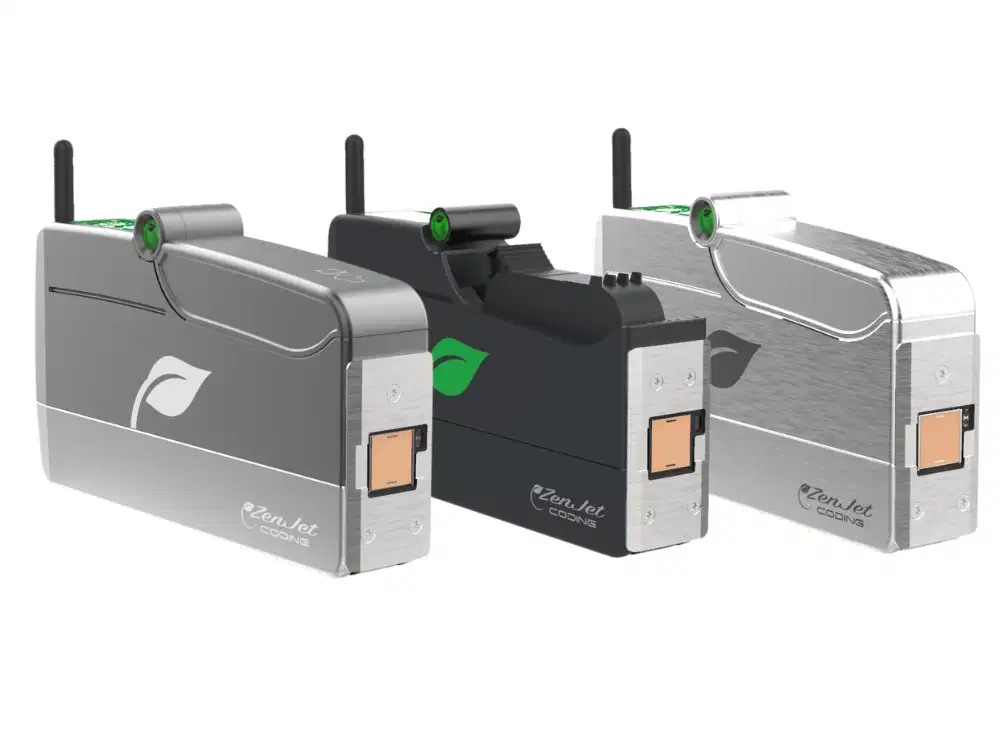
ZENJET CODING Thermal Inkjet Printer
FAQ.
What does a thermal inkjet printer print?
Variable data: expiry dates, batch numbers, barcodes, DataMatrix, QR codes, logos and texts, directly on the packaging.
What is the difference with continuous inkjet (CIJ)?
The TIJ ejects ink on demand from a cartridge, requiring no maintenance and offering high resolution. Continuous inkjet projects a continuous, deflected jet, suitable for different surfaces and speeds.
On what surfaces can printing be done?
On porous and non-porous substrates, cardboard, films, cases, labels, depending on the ink chosen.
Should the ink be water-based or solvent-based?
Water-based ink is suitable for porous surfaces such as cardboard; solvent-based ink adheres to non-porous surfaces such as plastic films.
Does the TIJ printer require maintenance?
Few: the print head is integrated into the cartridge, replaced when empty, which avoids cleaning the nozzles.
