
Features
Operating principle
Flexography is a relief printing process. A flexible printing plate carries the raised design; an anilox roller inscribes it evenly, and then the plate transfers the ink onto the substrate. The inks dry quickly. Each printing station prints one color; multiple stations allow for multi-color printing.
Integration
Printing is done sheet by sheet or web by web, in line with the processing of the substrate, manufacturing bags or boxes. The printing stations are linked according to the number of colors.
Options & configuration
Printing in two, three or four colours, sheet by sheet, water-based, solvent-based or UV inks, printing on paper bags, cartons and plates, pattern change according to series.
Benefits
Customized packaging produced in series.
Good adhesion on absorbent surfaces such as paper and cardboard.
Controlled operating costs.
High cadence over large sets.
The pattern changes from one series to another.
Reliable and easy-to-use machines.
Flexographic printing machine specialists

DCM ATN
Printing and converting machines for flexible packaging: gravure, flexo, coating, slitting.
Foodand beveragescosmeticspharmaceuticals
Primary packagingSecondary packagingPackaging machines
Expert images
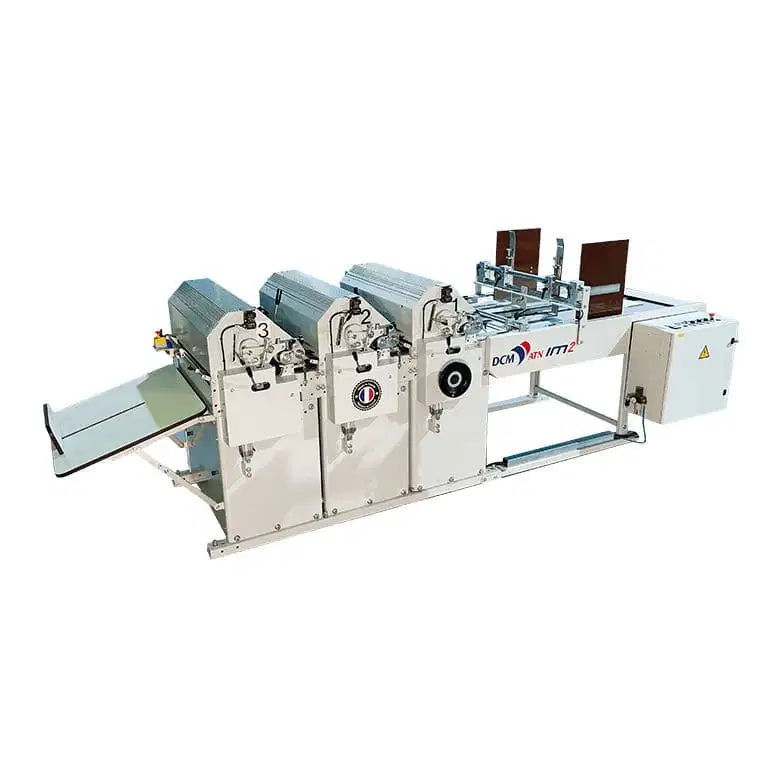
DCM ATN Flexographic Printing Machine
FAQ.
What is flexography?
It is a relief printing process: a flexible plate, inked by an anilox cylinder, transfers the design onto the substrate. It is particularly suitable for paper, cardboard, and films.
What is the difference between flexography and heliogravure?
Flexography prints from a relief plate; gravure prints from cells engraved in a cylinder. Gravure printing is intended for very large print runs and high image quality.
What types of media can be printed on?
Paper bags, cardboard boxes, sheets and packaging films.
How many colors can be printed?
As many as there are printing stations: two, three, four colors or more, each station applying one color.
What is the difference with an inkjet coding printer?
Flexography prints the decoration of the substrate in series; the coding printer marks variable data, such as dates and batch numbers, during packaging.
