

One of the village buildings, comprising 26 apartments, is equipped with an innovative wastewater filtration system for water from showers, kitchens, and toilets, allowing for its reuse. Thanks to NEREUS' NEOSTEP® solution, this water is purified to the point of being potable and is used for toilet flushing, washing machines, cleaning, and irrigating green spaces. Furthermore, this system recovers heat from the wastewater to heat domestic hot water. The goal of the Cycle building is to recycle 90% of wastewater and reduce water consumption by 60%, while also limiting energy consumption.
NEOSTEP® from NEREUS uses dynamic filtration technology for very low energy consumption
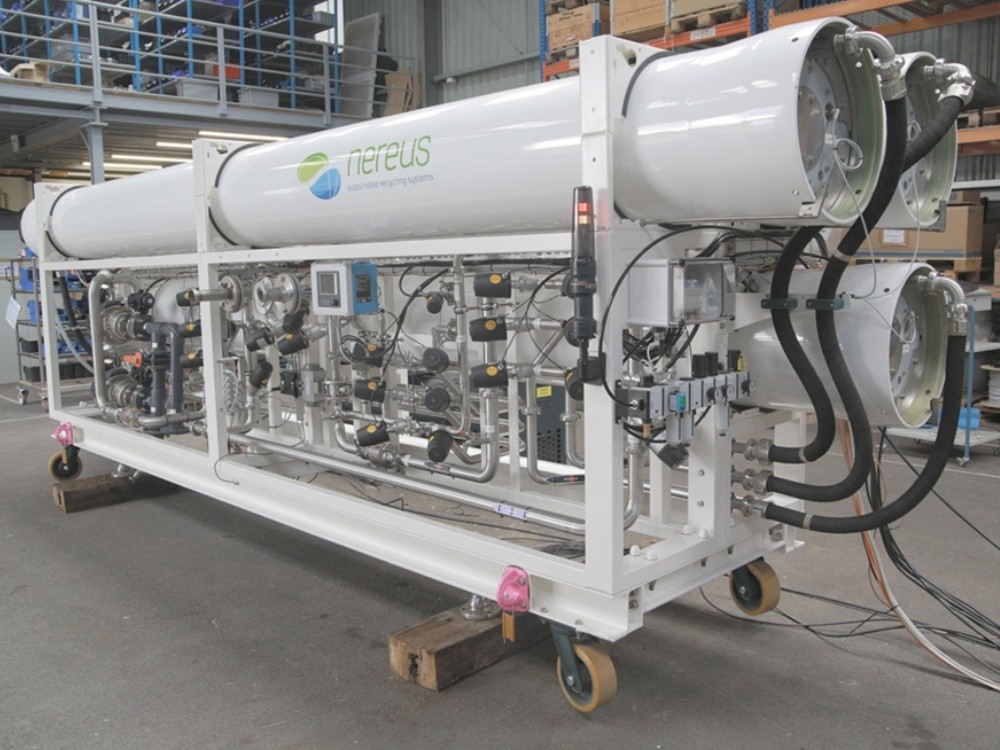
NEOSTEP® from NEREUS uses a dynamic filtration technology that consumes very little energy. Founded in 2013, NEREUS is a French leader in the field of dynamic filtration. Unlike traditional frontal filtration, where particles adhere to the filter surface, tangential flow filtration allows the fluid to pass through the filter under pressure, thus limiting particle accumulation. Dynamic filtration is an innovative variation of tangential flow filtration, offering high permeate flow rates and significantly reducing the risk of clogging thanks to high-shear rotating membranes. Furthermore, this method consumes approximately 80% less energy, making it both an efficient and environmentally friendly solution.
A solution available in the heart of cities
The compact NEOSTEP® wastewater treatment plant can be installed close to the point of use, whether in parks and gardens, eco-neighborhoods, or sustainable buildings. These plants are designed to be compact, are workshop-tested, and delivered ready to use. Guilhem Molles, Technical Director of NEREUS, emphasizes: “We need compact and, above all, reliable components, as it is crucial for us to avoid on-site repairs worldwide.” NEOSTEP® incorporates the latest membrane technology, enabling dynamic ultrafiltration combined with biological treatment, followed by a final reverse osmosis filtration stage. This solution recovers up to 49.7 kWh of heat per year, which is equivalent to preventing the emission of 9.2 tons of CO2.
SMC: Listening and a product difference
In the Olympic Village installation, 12 water circuits are managed, each controlled by three inclined-seat valves. These valves open and close the pipes for cleaning or shutting them down as needed. They are controlled by an SMC. Guilhem Molles explains: “After testing valves from numerous market players, we opted for SMC's offering due to its compact size and superior robustness. SMC's pneumatic valve units, water-resistant with their IP67 certification, are essential because the installations must be cleaned with water.” These pneumatic valve units are designed to withstand up to 5,000,000 cycles and feature IO-Link communication. Guilhem Molles adds: “For more corrosive environments, such as coastal or tropical areas, we worked closely with SMC and used AMG water separators, allowing us to remove up to 99% of the water, as well as FRL AC 40D treatment units.”
A solution for the future
“ This technology is very promising, thanks to its low energy consumption. Although the price of the membranes remains high, the return on investment is estimated at around five years ,” explains Guilhem Molles. But their costs are constantly decreasing. Currently, applications are mainly concentrated in industry and the service sector, but the advantages of this technology suggest an expansion into wastewater treatment plants, which are major energy consumers. SMC supports Nereus in all these developments.